 Skip to content

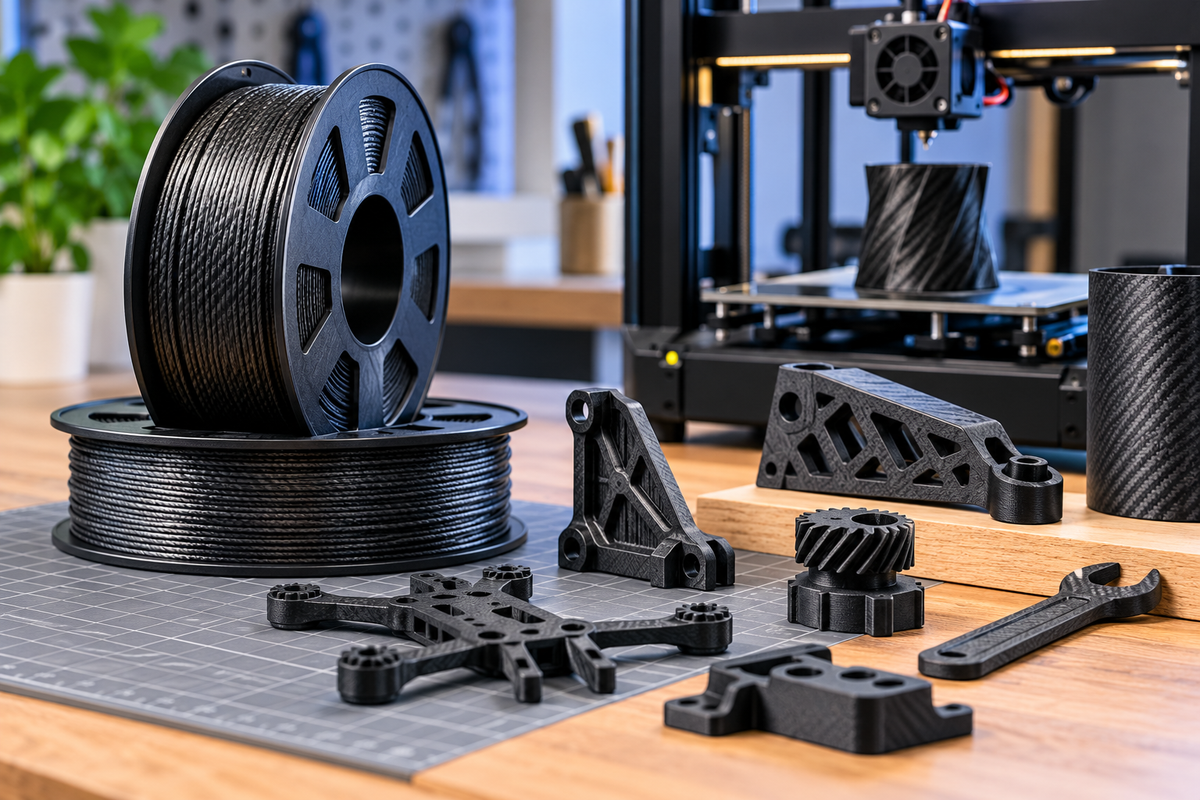
A printed part can look perfect and still fail when it faces pressure, heat or repeated use. That is why choosing the right filament matters. Carbon fibre filament can help make parts stiffer, lighter and more accurate, depending on the plastic used. But it also comes with limits, from nozzle wear to printing difficulties. Pick the wrong type, and the finished part may not do the job. This carbon fibre filament guide explains the benefits, drawbacks and uses in simple terms, so you can choose a material that suits your project.
What Makes Carbon Fibre Filament Different?
Carbon fibre filament combines plastic with tiny carbon fibres. The plastic forms the part, while the fibres can help it resist bending and hold its shape.
However, carbon fibre filament is not one single material. PLA, PETG, ASA, polycarbonate and nylon all behave differently. Adding carbon fibres does not give them the same heat resistance, impact strength or moisture resistance.
Think about the job first. A mounting bracket, a drone part and a workshop tool face different demands. The right filament depends on the load, working temperature, surrounding conditions and how the finished part will be used.
Where Carbon Fibre Filament Benefits Make a Difference
Why use carbon fibre filament in the first place? Its main advantage is stiffness. Some carbon fibre reinforced materials resist bending better than their standard versions. The exact result depends on the plastic, fibre content and print settings.
Other carbon fibre filament benefits can include:
- A Distinctive Finish: The dark, textured surface can give a part a technical look without extra coating.
- Better Shape Retention: Some formulations help parts hold their shape, which can be useful for fitted components.
- Lower Part Weight: Certain designs can meet weight targets without bulky parts, although the actual weight depends on the material and design.
- Functional Prototypes: Designers can test fit, assembly and selected material properties before moving to another manufacturing method.
One point matters here. Stiffness and toughness are different. Stiffness means a part resists bending. Toughness means it can absorb energy before breaking. A rigid part can still crack if it takes a sharp hit.
Match the Plastic to Your Project
The plastic base affects how the filament handles heat, impact and moisture. Use this table to compare common options before choosing a spool.
|
Material |
Common Uses |
Main Limitation |
|
PLA CF |
Prototypes, fixtures and decorative functional parts |
Limited heat resistance |
|
PETG CF |
Workshop jigs, brackets and selected drone parts |
Check impact needs and layer bonding |
|
ASA CF |
Outdoor housings and exterior fixtures |
Needs suitable printing conditions |
|
PA6 CF |
Demanding mechanical parts |
Needs careful drying and moisture control |
|
PA12 CF |
Parts exposed to oils or fuels |
Check electrical and load requirements |
|
PC CF |
Parts that need greater heat resistance |
More demanding printing requirements |
PLA CF is useful for parts that need stiffness and a neat finish but do not face high temperatures.
PETG CF can suit brackets and workshop fixtures that need stiffness alongside impact performance. Check the specifications for the exact product before use.
ASA CF is worth considering for outdoor parts because ASA offers UV resistance. An enclosure and suitable temperature control may be needed during printing.
PA6 CF and PA12 CF can suit demanding engineering jobs. Both need careful moisture control, and the correct drying process matters.
PC CF may suit parts that face higher temperatures. Check that your printer can reach the required settings before buying the filament.
Which Carbon Fibre Filament Applications Are Worth Considering?
Carbon fibre filament makes the most sense when a part needs specific properties, rather than just an unusual finish.
- Manufacturing: Print jigs, assembly fixtures, positioning aids and workshop tools that need to keep their shape.
- Drones and Robotics: Make suitable housings, mounts and selected frame parts. Test for vibration, impact and flight loads before use.
- Automotive Workshops: Produce non-structural brackets, sensor mounts, tool holders and assembly fixtures. Safety-related vehicle parts need proper engineering checks.
- Industrial Maintenance: Make replacement covers, holders and other non-critical components when the plastic suits the working conditions.
- Product Development: Check fit, mounting points and selected functions before spending money on production tooling.
A stiff part is not automatically ready for real-world use. Print direction, layer bonding, wall thickness and internal structure all affect performance. Aircraft parts and other regulated applications also need the required engineering checks and approvals.
Avoid Printing Mistakes That Waste Filament
A suitable filament can still produce a poor part if the printer settings are wrong. Check these points before you start.
- Use a Wear-Resistant Nozzle: Carbon fibres can wear brass nozzles over time. A hardened steel or suitable ruby nozzle can help reduce this problem.
- Check the Printer Requirements: ASA CF and PC CF may need an enclosure and a heated bed.
- Dry Moisture-Sensitive Filament: Nylon can absorb moisture, leading to stringing, surface defects and uneven extrusion. Follow the manufacturer's drying instructions.
- Set the Right Temperature: Too little heat can weaken the bond between layers. Too much heat can damage the material.
- Inspect the Finished Part: Check holes, layer lines, surface defects and load-bearing areas before using the component.
Post-processing needs care, too. Sanding carbon fibre parts can release fine dust. Use suitable eye and respiratory protection, along with dust extraction, and follow the product's safety data sheet.
Why Marble PLA Needs the Right Nozzle, Too
Carbon fibre is not the only filament that can wear a nozzle. Marble PLA contains stone-like particles that create a patterned finish. It serves a different purpose, but its filler can also be abrasive.
Marble PLA works well for decorative models, architectural models and jewellery. It gives printed objects a stone-inspired appearance without using real marble. A layer height of 0.2 mm or greater can help bring out the pattern, depending on the printer and model.
3D META's Marble PLA comes in Natural, Blue, Brown and Red. Its listed nozzle temperature is 190°C to 220°C, and its drying instructions specify five hours at 50°C. Follow the current product settings and use a wear-resistant nozzle. If you are considering 3d printing marble filament, treat these settings as a starting point and check the latest product information.
The key point is simple. Fillers affect how a filament prints, not just how the finished part looks. A nozzle that works well with standard PLA may not suit an abrasive filament.
Check the Specifications Before You Print
A filament's name cannot tell you exactly how a finished part will perform. Check the technical data sheet before choosing a material. Look for tensile strength, flexural properties, heat deflection temperature and impact performance, where these details are available.
Here is what those figures mean:
- Tensile Strength: How much stress a test specimen can take when pulled.
- Flexural Modulus: How stiff a material is when bent.
- Heat Deflection Temperature: The temperature at which a test specimen bends under a stated load.
- Impact Strength: How a material responds to a sudden force under specific test conditions.
These figures do not guarantee that every printed part will be safe for a particular job. Test results depend on the test method and specimen. The finished part also depends on its shape, print direction and layer bonding.
3D META stocks carbon fibre PLA CF, PETG CF, ASA CF, PC CF, PA6 CF and PA12 CF, with product pages listing print settings and technical specifications. The range also includes Marble PLA for decorative prints.
Before you print, check your printer's limits, nozzle type, drying instructions and the conditions the part will face. Use the specifications for the exact filament you choose. Settings and test results for another material are not a safe substitute.
Final Word
Carbon fibre filament can be a smart choice for parts that need stiffness, shape retention or specific engineering properties. But the right result depends on choosing the correct plastic, setting up the printer properly and checking the finished part. 3D META stocks six carbon fibre filament types, with product specifications, printing instructions and downloadable data sheets. The Australian-owned retailer ships orders from its Melbourne warehouse and offers technical advice from 3D printing specialists. Use this carbon fibre filament guide to compare your options and choose a filament that fits the job.