 Skip to content


Description
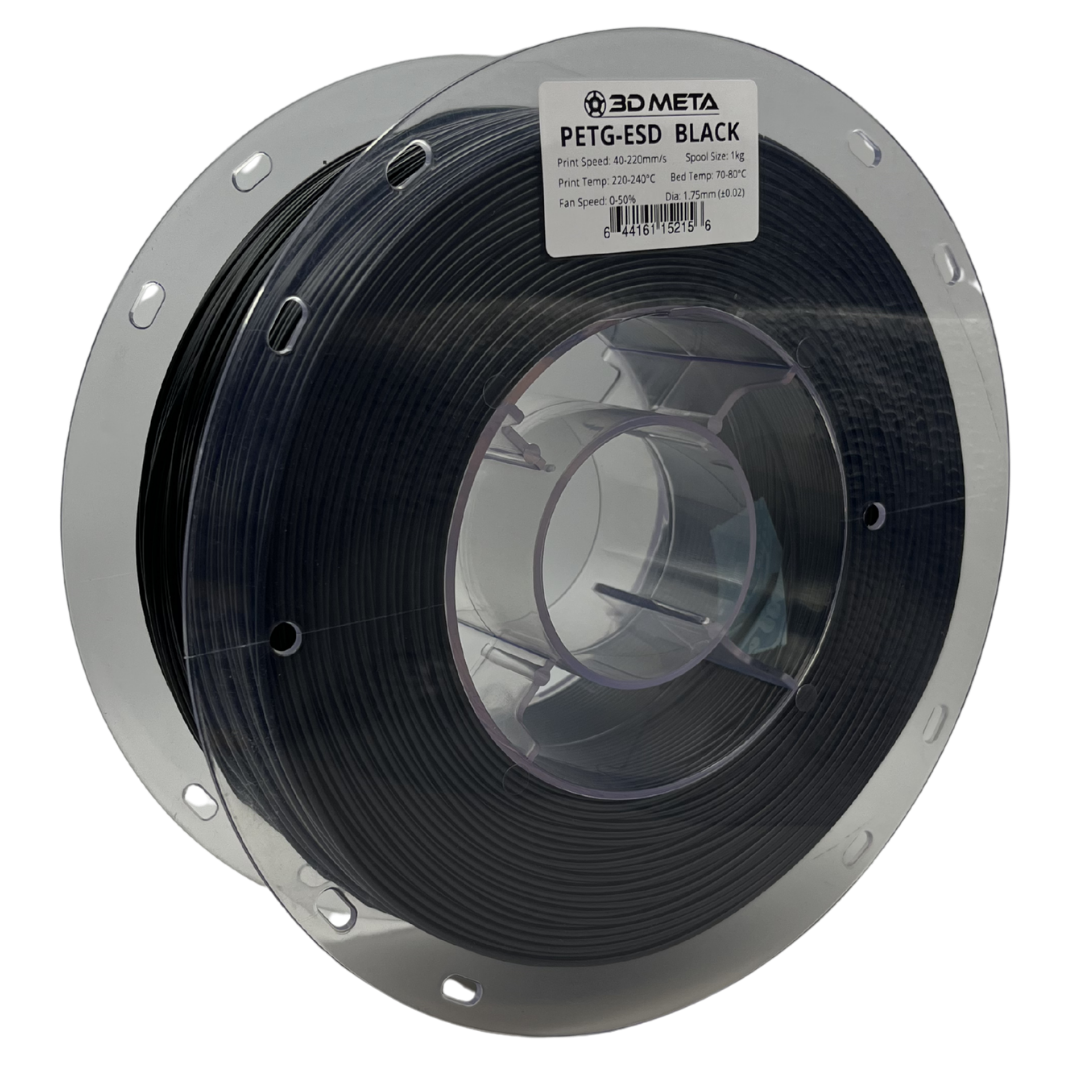
PETG-ESD 3D Printing Filament
3D META's PETG-ESD 3D printing filament combines the easy-to-print nature of PETG with reliable electrostatic discharge protection. By blending premium PETG with carefully dispersed conductive additives, PETG-ESD delivers a controlled surface resistivity that safely dissipates static charges — making it the ideal choice for printing trays, jigs, and enclosures that handle sensitive electronics. Unlike ABS-ESD, PETG-ESD prints without an enclosure on most modern printers, offering excellent layer adhesion, low warping, and good chemical resistance. Like all 3D META filaments, PETG-ESD is manufactured to strict quality standards and supplied on recyclable plastic spools.
Key Features of PETG-ESD 3D Printing Filament
• ESD-Safe Performance: Surface resistivity in the 10⁶–10⁹ Ω range provides reliable static dissipation for handling sensitive electronic components.
• Manufactured with High-Quality Materials: Premium PETG base with uniformly dispersed conductive additives for consistent ESD behaviour across every spool.
• Easier to Print Than ABS-ESD: PETG-ESD prints reliably without an enclosure and is far less prone to warping or layer separation.
• Good Chemical Resistance: Resistant to many common solvents, oils, and cleaning agents found in electronics manufacturing environments.
• Strong Layer Adhesion: Excellent inter-layer bonding produces tough, durable parts suitable for repeated production use.
• Low Warping and Dimensional Stability: Maintains accurate dimensions and tight tolerances throughout long prints.
• Strict QA Manufacturing: Every batch is verified for diameter consistency and ESD performance.
Applications for PETG-ESD 3D Printing Filament
PETG-ESD is designed for engineers, electronics manufacturers, and makers who need ESD-safe parts that are quick and easy to print:
• Electronics Trays and Carriers: Custom storage and transport trays for PCBs and components.
• Assembly Jigs and Fixtures: Hold and locate sensitive components during build, test, and rework without ESD risk.
• Enclosures for Prototype Electronics: Print housings for prototype boards and ESD-sensitive devices.
• Tooling for Electronics Production: Suction cups, end-effectors, and line tooling for automated electronics assembly.
• Lab and Cleanroom Accessories: Custom holders, organisers, and tools for environments where static control matters.
Note: PETG-ESD is mildly abrasive due to its conductive additives. A hardened steel nozzle is recommended for extended use.
Storage and Drying for PETG-ESD Filament
Like all PETG-based and conductive-filled materials, PETG-ESD performs best when kept dry:
• Store in a Cool, Dry, Dark Environment: Use airtight containers or resealable bags with fresh desiccants between prints.
• Drying Recommendations: If moisture is suspected, dry PETG-ESD using a filament dryer, food dehydrator, or enclosed 3D printer at 60–65°C for 4–6 hours.
Why Choose 3D META's PETG-ESD 3D Printing Filament
• Easy-to-Print ESD Performance – All the reliability of PETG combined with consistent static dissipation.
• Top-Quality Materials – Premium PETG resin and high-grade conductive additives for stable, repeatable performance.
• Strict QA Standards – Verified ESD performance and tight diameter tolerance, batch after batch.
• Fully Tested In-House – Every batch is print-tested on production-style geometries before release.
• Constant Innovation – 3D META continually expands its engineering-grade filament range based on customer needs.
Ready to print ESD-safe parts without the hassle of ABS? Order 3D META PETG-ESD filament today and protect your electronics with confidence.
Print Settings
Technical Specs
FAQs
1. What surface resistivity does PETG-ESD provide?
PETG-ESD delivers a surface resistivity in the 10⁶–10⁹ Ω range, classified as static dissipative — appropriate for handling and protecting ESD-sensitive electronic components.
2. What temperature should I print PETG-ESD at?
Print at 230–250°C with a heated bed at 70–85°C. PETG-ESD does not require an enclosure but benefits from a stable ambient temperature for best layer adhesion.
3. How does PETG-ESD compare to ABS-ESD?
PETG-ESD is significantly easier to print — no enclosure required, far less warping, and better chemical resistance. ABS-ESD offers higher heat resistance (around 100°C glass transition) for warmer environments.
4. Do I need a hardened nozzle?
Yes — a hardened steel nozzle is recommended. The conductive additives in PETG-ESD will wear out a brass nozzle faster than standard PETG, especially over long production runs.