 Skip to content


Description
PETG-GF (Glass Fibre Reinforced) 3D Printing Filament
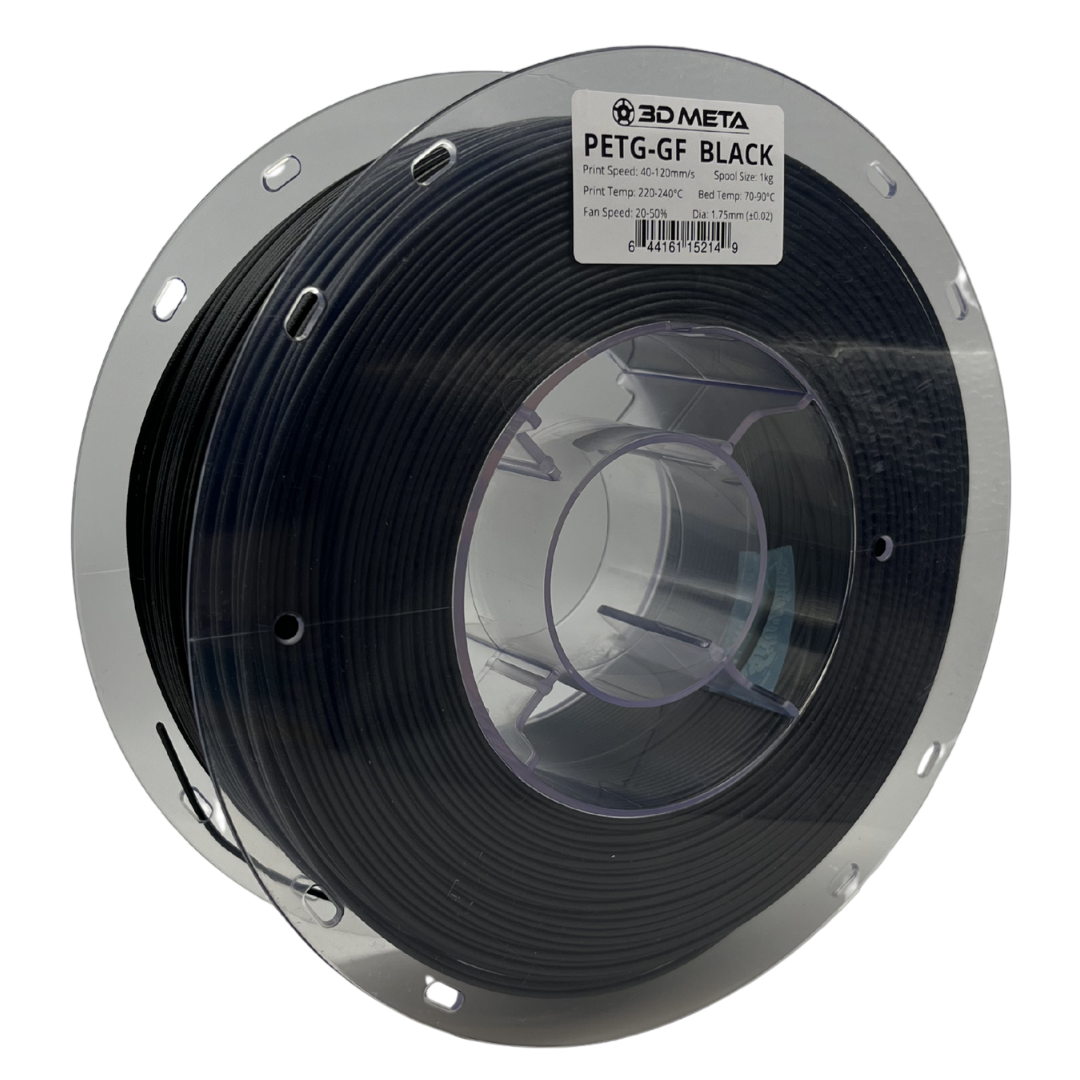
3D META's PETG-GF 3D printing filament is a glass-fibre reinforced PETG engineered for users who need stiffer, stronger, more dimensionally stable parts than standard PETG can deliver. The addition of chopped glass fibres dramatically increases tensile strength, rigidity, and heat deflection while significantly reducing warping and shrinkage on large prints. The result is a high-performance engineering filament suitable for brackets, structural components, drone frames, and functional prototypes that need to perform under load. Like all 3D META filaments, PETG-GF is manufactured to strict tolerances and supplied on recyclable plastic spools.
Key Features of PETG-GF 3D Printing Filament
• Glass-Fibre Reinforced: Chopped glass fibres significantly boost stiffness, tensile strength, and heat resistance compared to unfilled PETG.
• Manufactured with High-Quality Materials: Premium PETG base with uniformly distributed glass-fibre reinforcement for consistent mechanical performance.
• Outstanding Dimensional Stability: Glass fibres dramatically reduce warping, shrinkage, and creep — ideal for large parts and tight tolerances.
• Increased Heat Resistance: Higher heat deflection temperature extends the working range beyond standard PETG.
• Attractive Matte Finish: Glass-fibre composites naturally produce a matte, technical-looking surface that hides layer lines well.
• Excellent Layer Adhesion: Strong inter-layer bonding maintains the mechanical advantages of the composite throughout the part.
• Strict QA Manufacturing: Every batch is checked for diameter, fibre dispersion, and print performance.
Applications for PETG-GF 3D Printing Filament
PETG-GF is built for engineering and production users who need real mechanical performance:
• Structural Brackets and Mounts: Load-bearing parts that need stiffness, strength, and dimensional accuracy.
• Drone and RC Frames: Lightweight, rigid frames that hold tolerance under vibration and impact.
• Functional Prototypes: Test parts that need to behave more like final-product engineering materials.
• Jigs and Fixtures: Production aids that maintain accuracy in workshop environments.
• Automotive and Robotics Components: Internal brackets, mounts, and housings where stiffness and heat resistance matter.
Note: Glass-fibre reinforced filaments are highly abrasive. A hardened steel or ruby nozzle is required — a standard brass nozzle will wear out very quickly.
Storage and Drying for PETG-GF Filament
Glass-fibre composites print best when thoroughly dry:
• Store in a Cool, Dry, Dark Environment: Use airtight containers or vacuum-sealed bags with fresh desiccants.
• Drying Recommendations: Dry PETG-GF before printing if stored for more than a few days. Use a filament dryer, food dehydrator, or enclosed 3D printer at 65–70°C for 4–6 hours.
Why Choose 3D META's PETG-GF 3D Printing Filament
• Real Engineering Performance – Stiffer, stronger, more dimensionally stable than standard PETG.
• Top-Quality Materials – Premium PETG and consistent fibre reinforcement for reliable mechanical properties.
• Strict QA Standards – Tight diameter tolerance and verified print performance, batch after batch.
• Fully Tested In-House – Every batch is print-tested on representative engineering geometries before release.
• Constant Innovation – 3D META is committed to expanding its engineering-grade filament range based on customer feedback.
Ready to print parts that perform like engineering components? Order 3D META PETG-GF filament today and step up to glass-fibre reinforced strength.
Print Settings
Technical Specs
FAQs
1. Do I need a hardened nozzle to print PETG-GF?
Yes — a hardened steel, tungsten carbide, or ruby nozzle is required. Glass fibres are highly abrasive and will erode a brass nozzle within hours of printing.
2. What temperature should I print PETG-GF at?
Print at 240–260°C with a heated bed at 75–90°C. Slightly higher temperatures than unfilled PETG help maintain flow and improve fibre wet-out for stronger parts.
3. How much stronger is PETG-GF than standard PETG?
PETG-GF typically offers 1.5–2x the tensile modulus and significantly higher heat deflection temperatures than unfilled PETG, along with greatly reduced warping on large or dimensionally critical prints.
4. Can I sand or paint PETG-GF prints?
Yes. PETG-GF sands well and accepts paint with appropriate preparation. The natural matte finish often looks great unfinished, hiding layer lines and giving prints a professional, technical appearance.